
Agile Was Designed for Humans. It Works Surprisingly Well for AI Agents.
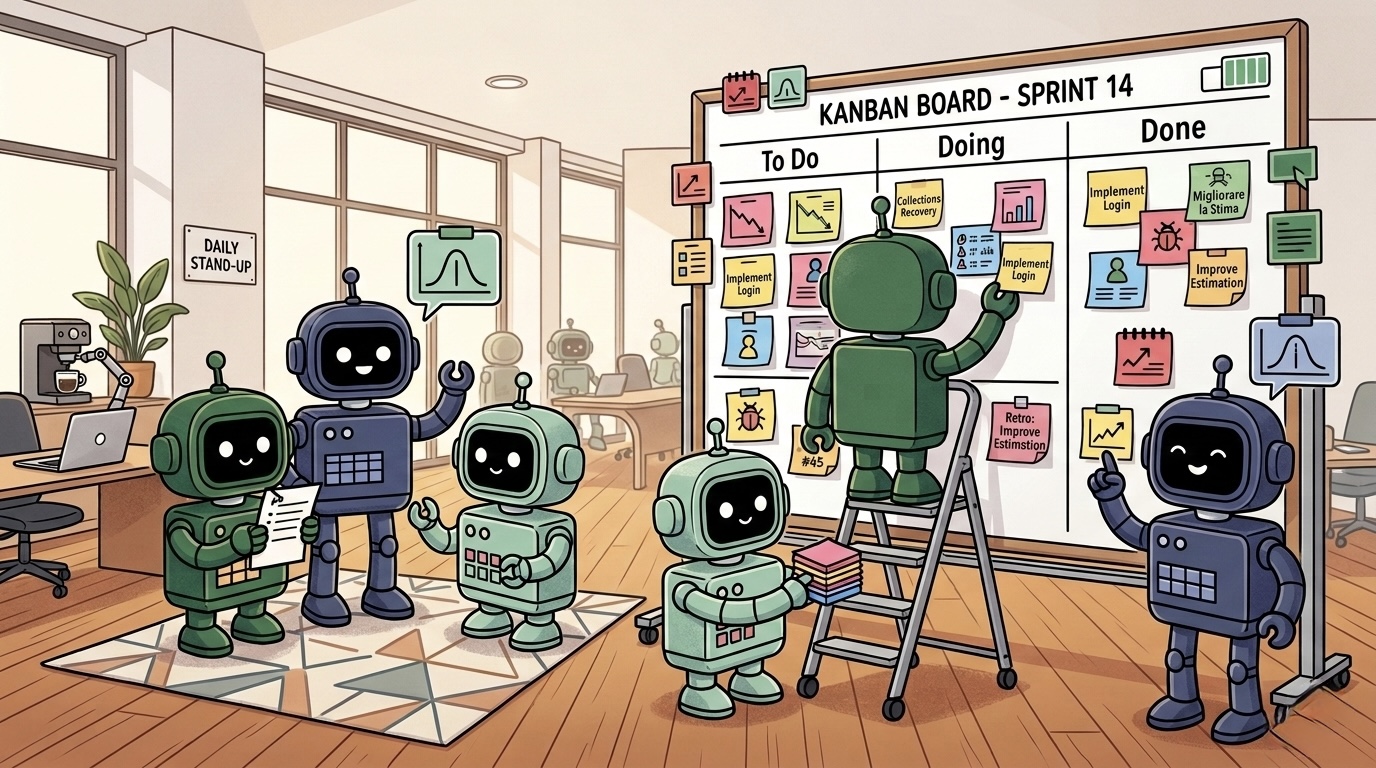
Agile Was Designed for Humans. It Works Surprisingly Well for AI Agents, but for Entirely New Reasons.
When the Agile Manifesto changed the way software was developed in the early 2000s, the problem it addressed was clear: teams of people who could not coordinate, requirements that changed faster than they could be documented, projects that derailed because nobody had visibility into what was actually happening.
The solution was equally clear: break work into small increments, validate often, adapt continuously. Epics, user stories, tasks. Sprints, reviews, retrospectives. Sticky notes on a board. All designed to reduce the risk of miscommunication between human beings.
Twenty years later, we are discovering that the very same structure works excellently for an entirely different kind of "developer": AI agents. But the reasons it works are not the original ones, and understanding this distinction is essential for anyone integrating AI into their software development processes.
Same Framework, Different Problem
Miscommunication between people is not the main challenge for AI agents. An agent has no ego, does not misread an email, does not forget what was said in a meeting because it was checking its phone.
The problem with agents is different: context drift. As an agent works on a task, its context becomes saturated. The more information it processes, the greater the risk of losing focus on the original objective. It is a bit like asking someone to solve a puzzle while continuously pouring pieces from a different puzzle on top of them.
This is where the Agile structure proves useful for entirely new reasons. Breaking work down into epics, user stories, and tasks is no longer about facilitating communication between people: it is about partitioning context so that the agent can operate with a defined focus without being caged by overly rigid instructions.
Epics, User Stories, Tasks: What Changes When You Use Them for Agents
Epics: the information estate as a starting point
In a traditional Agile process, epics often emerge from a combination of the product owner's intuition, user feedback, and business objectives. With agents, the starting point becomes much richer.
Consider what is possible today: gathering project documents, call transcripts, emails, and technical specifications, then using specialized agents to synthesize all this material into structured epics. This is not a simple summary: the agent can cross-reference information from different sources, identify implicit requirements, and highlight contradictions between documents.
The result is epics that start from an informational foundation that no product owner, however skilled, could process manually in the same amount of time.
User stories: when existing code enters the design
This is where things get interesting. In traditional user stories, existing code is an "implementation detail" that lives in the developers' heads. The user story describes the what; the how is the implementer's problem.
With agents, this separation loses its meaning. If an agent needs to generate a user story that will later be implemented by another agent (or by itself), including the context of the existing code in the story is not excessive detail: it is a fundamental design act. The agent analyzing the codebase can indicate in the user story which modules will be affected, which architectural patterns to follow, which dependencies to consider.
This does not make the user story prescriptive. It makes it aware. It is the difference between saying "the user must be able to filter results by date" and saying "the user must be able to filter results by date; the current search module uses Elasticsearch with an index structured like this, and the frontend manages filters through this React component."
Tasks: the most significant inversion
This is probably the deepest transformation, and it is worth thinking through carefully.
In classic Agile practice, there was an unwritten rule: tasks should not be too detailed. The reasoning was pragmatic -- since the real output is the code, spending too much time describing a task in detail meant doing the work twice. Better to write a minimal description and then move straight to writing code.
With agents, this logic is completely reversed.
A detailed task is no longer duplicated work: it is the true design artifact. It is, in effect, the "prompt" that will guide the agent in generating code. The more precise the task is in defining the context, constraints, acceptance criteria, and expected behavior, the better the agent will be at producing code aligned with the original intent.
And there is an additional advantage: a detailed task, however rich, is still enormously faster for a human to read and validate than the code it produces. Ten lines of task that precisely describe what to do are easier to verify than two hundred lines of code. This means the developer can focus their time on validating the design (the task) rather than the implementation (the code), where human value-add is highest.
Feedback Loops: Natural Checkpoints for Human-Agent Collaboration
If there is one Agile principle that not only survives but becomes even more central with agents, it is continuous feedback.
In an agent-based workflow, the transition moments between levels (from epic to user story, from user story to task, from task to code) become natural checkpoints where the human reviews, corrects, and enriches the agent's work. This is not simple approval: it is genuine collaboration, where the developer or product owner can involve colleagues, gather input from multiple people, and return structured collective feedback to the agent.
But the loop does not close there. The most interesting part comes after code generation. When the code produced by the agent is compared against the approved tasks and user stories, a further feedback cycle opens. The developer can verify whether the implementation respects the design's intentions, and if it does not, they can continue iterating directly in the development tool: the agent reads the comments on a GitHub pull request, corrects, resubmits, until all criteria are satisfied.
It is Agile in its purest form: short cycles, rapid feedback, incremental improvement. Except now the cycle includes a new participant that does not get tired, does not lose context between one round of feedback and the next (provided the context has been properly partitioned), and can iterate at a speed that was previously unthinkable.
How FairMind Implements This Approach
At FairMind, we built our platform around precisely these principles.
The process starts with gathering the information estate: project documents, emails, call transcripts, technical specifications. Our specialized agents synthesize this material into structured epics, cross-referencing information and identifying requirements that often remain implicit in conversations between stakeholders.
When moving to user stories, the platform begins integrating the context of the existing code. Agents analyze the codebase to understand how to shape user stories based on the real architecture, not the theoretical one. This is particularly important for the European companies we work with, which often have significant legacy codebases: the user story cannot ignore twenty years of layered technical decisions.
At the task level, agents dissect the code in depth. Each task becomes a rich design document that includes the relevant architectural context, specific constraints, and verifiable acceptance criteria. This is where context is managed most carefully: the agent can trace back to the original epic inputs if needed, but its focus remains on the portion of the codebase relevant to that single task.
And at every step, the platform provides moments for collaborative feedback. Users can review, comment, involve colleagues, and provide agents with structured feedback before moving to the next level. After code generation, the loop continues: the agent monitors pull request comments and iterates until the implementation is aligned with the approved design.
Bigger Sticky Notes, Faster Cycles
There is one final reflection worth sharing. The sticky note rule -- the one that said a user story should fit on a Post-it -- was a brilliant constraint. It forced synthesis, reduced increment size, and facilitated feedback.
With agents, that physical constraint no longer makes sense. User stories and tasks can and should be richer, because the agent needs context to work well and because, unlike a human reading a sticky note between meetings, the agent processes all content with the same level of attention.
But the principle behind the sticky note remains valid: keeping increments manageable, validatable, reversible. What changes is the scale. A "manageable increment" for an agent is simply larger than one for a human team, because both production and validation happen more quickly.
We are not abandoning Agile. We are scaling it for a new kind of collaborator working alongside us, and we are discovering that the principles we designed for our human limitations work equally well for entirely different limitations. Perhaps that is a sign those principles were deeper than we thought.
Ready to Transform Your Enterprise Software Development?
Join the organizations using FairMind to revolutionize how they build, maintain, and evolve software.