
Harness Engineering: The Discipline That Determines Whether AI Agents Ship or Stall
Harness Engineering: The Discipline That Determines Whether AI Agents Ship or Stall
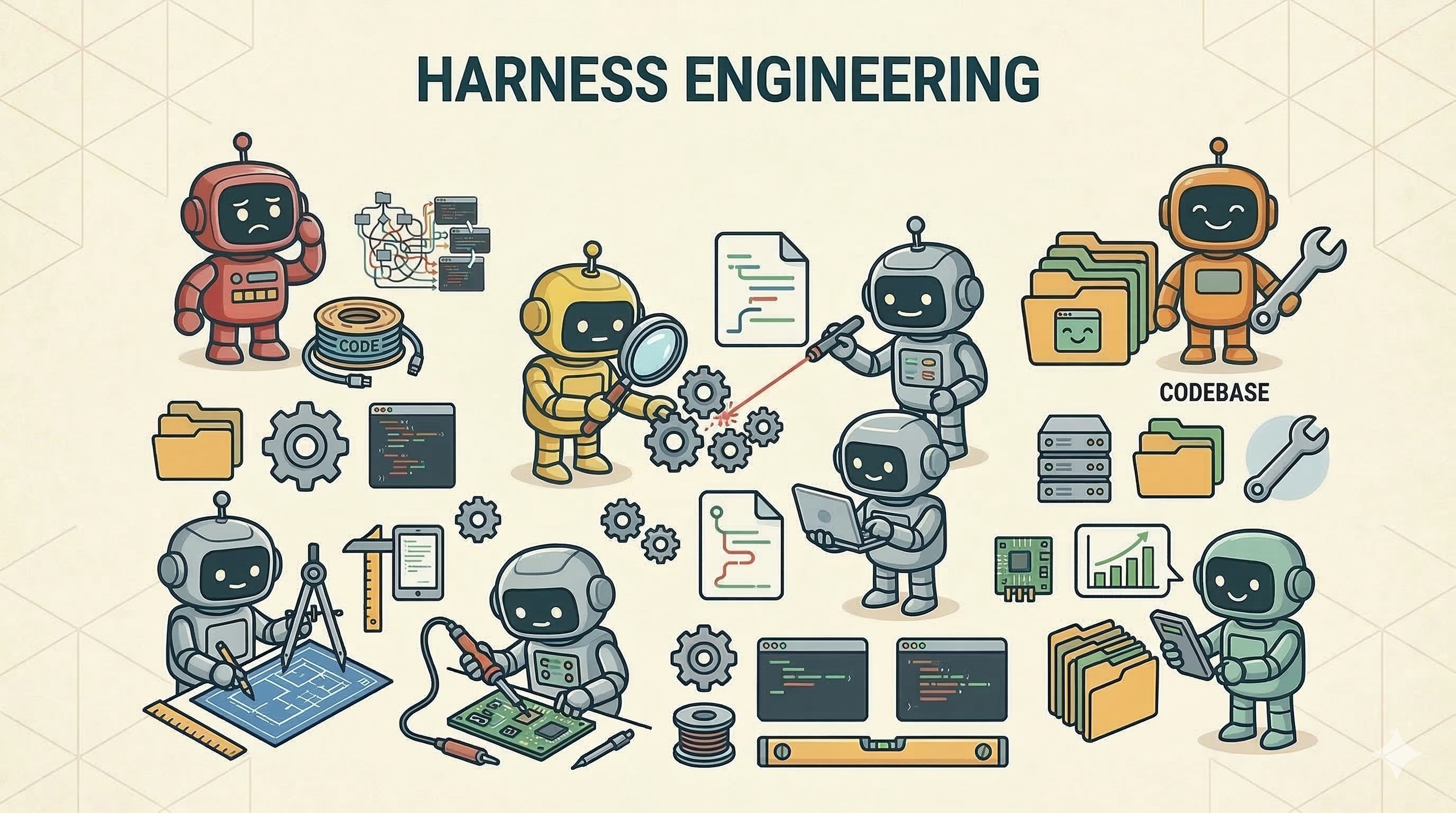
Executive Summary. Harness engineering is the practice of structuring codebases, tooling, and engineering culture to maximize the productive output of AI coding agents. At FairMind, we have been practicing this discipline internally for over a year, building our own platform with AI agents at the center of the development workflow. What started as a set of hard-won operational lessons has converged with a broader industry movement: in early 2026, organizations including Stripe, OpenAI, Anthropic, LangChain, and LlamaIndex began documenting similar patterns independently. The convergence is significant. This article presents the framework we developed from our direct experience, validated by the emerging industry evidence, and now being applied and enriched through engagements with our clients.
Why This Discipline Exists
Most engineering organizations adopting AI coding tools follow a predictable trajectory. They approve licenses for tools like Copilot, Cursor, or Claude Code. Adoption looks strong in the first weeks. Then the complaints surface: review cycles get longer, senior engineers report that AI-generated code violates architectural conventions, and there is no consistency across teams in how agents are used. The board asks about ROI and there is no clean answer.
We know this trajectory because we lived it ourselves.
When we started building FairMind's platform with AI agents as the primary development mechanism, we hit every one of these problems. Agents produced code that looked correct but violated internal conventions. The review burden on senior engineers increased instead of decreasing. Context was scattered, constraints were implicit, and feedback loops were too slow.
The difference is that we treated these failures as design problems, not tool problems. Every time an agent made a recurring mistake, we asked: what is missing from the environment? Over months of iteration, a structured discipline emerged. We later discovered that the most advanced engineering organizations in the world were arriving at the same conclusions through independent paths.
The Industry Convergence
In February 2026, several things happened almost simultaneously. Stripe documented that it was merging over 1,000 PRs per week from fully unattended agents. OpenAI published results from a five-month internal experiment building production software with zero manually written lines of code. Anthropic pushed the boundary further, tasking 16 parallel Claude instances to build a C compiler from scratch: nearly 2,000 agent sessions, 100,000 lines of Rust code, capable of compiling the Linux kernel, with lessons on test harness design, context management, and multi-agent coordination that directly validate the patterns described in this article. Practitioners at LangChain and LlamaIndex began publishing frameworks and analyses that all pointed to the same structural insight: the bottleneck to AI-driven development is not the model. It is the environment.
A research synthesis covering 60+ distinct sources documented how the term "harness engineering" propagated from practitioner terminology to an industry-wide discipline within a compressed 30-day window. This is not a marketing concept. It is a name for a set of engineering practices that multiple organizations discovered independently through production experience.
What makes this convergence credible is that the sources are structurally diverse: infrastructure companies, AI labs building with their own models, framework developers serving thousands of teams, and production-scale fintech operations. When independent actors converge on the same patterns, the signal is strong.
Three Foundational Patterns
We identified three structural patterns in our own practice before we saw them confirmed across the industry. Each addresses a specific failure mode we encountered building FairMind.
Pattern 1: Context as Infrastructure
When we first deployed agents on our codebase, the most common failure was not code quality: it was code that ignored context. Agents would use deprecated libraries, violate service boundaries, or duplicate functionality that already existed elsewhere. The agents were not malfunctioning. They simply could not see the information they needed.
Our response was to build what we call the Project Context: a structured repository that contains the full codebase, architectural documentation, decision records, and all artifacts produced by agents themselves (brainstorming documents, impact analyses, code documentation). The codebase portion updates automatically; documentation is curated by the team. Critically, when our agents produce artifacts like brainstorming sessions or architectural analyses, those artifacts are automatically saved back into the Project Context, creating a self-reinforcing knowledge base.
This inverts the traditional relationship between code and documentation. In agent-first development, the information environment that an agent navigates is infrastructure, not an afterthought. Poorly structured context produces unpredictable agent behavior. Well-structured context enables agents to operate autonomously within intended boundaries.
The industry pattern mirrors this precisely. Leading organizations have converged on structured documentation files (commonly called AGENTS.md) that orient agents to the codebase, curated documentation directories designed for agent consumption, and explicit architectural guidance that agents can parse in-session.
Pattern 2: Constraint as Enabler
This is the most counterintuitive pattern, and the one that took us longest to internalize. Engineers are trained to value flexibility. In agent-first environments, the opposite holds: the more constrained and predictable the runtime, the more autonomy you can safely give the agent.
We learned this the hard way when we discovered that agents, left unconstrained, produced code that passed basic checks but violated invisible architectural rules. Our response was to build enforcement into the environment itself: custom linters, rigid dependency management, automated architectural checks that run before any human ever sees the output. When an agent can only import from approved libraries, only call across defined service boundaries, and only structure code in approved patterns, the output is consistent by construction, not by hope.
At FairMind, we went further. We built specialized agents and skills that operate inside development tools (Claude Code, GitHub Copilot, and others): a cybersecurity agent, a code review agent, and a set of hooks that enforce process compliance before code is even committed. These are not optional guidelines. They are structural constraints that make violations impossible rather than merely detectable.
Stripe, implementing this at scale, runs lint in under five seconds with autofixes that execute before human review. The principle is the same at any scale: constraints that close fast enough for the agent to self-correct inside the same work context are enablers, not gates.
Pattern 3: The Maintenance Loop
The first two patterns create the initial environment. The third pattern keeps it healthy over time.
Every agent session produces drift: small inconsistencies, accumulated technical debt, gradual divergence from intended patterns. Without a systematic mechanism to detect and correct this drift, the environment degrades and agent output quality drops.
Our solution was the development journal: a structured log that every agent is required to produce during development, documenting activities performed, decisions made, files modified, and rationale for each choice. When code is pushed, a dedicated agent in our CI/CD pipeline reads these journals and compares them against what was planned in FairMind, producing a gap analysis table that identifies what aligns with the plan, what deviates, and what remediation is needed. The developer can then read the PR, see exactly where the gaps are, and complete what needs completing.
This is not a nice-to-have: it is the mechanism that makes agent-driven development auditable and correctable. Without it, errors compound silently. With it, every development cycle produces both code and a traceable record of intent versus execution.
The broader industry pattern echoes this: leading practitioners describe periodic cleanup mechanisms, "garbage collection" agents, and session isolation patterns that treat each agent session as a work shift for an engineer with no memory of previous shifts. The structural insight is the same: agent-driven development requires deliberate state management and continuous environmental maintenance.
Observability and Human-in-the-Loop Control
One pattern we have not seen discussed adequately in industry literature is agent observability, not just of outputs, but of the agent's internal reasoning and memory.
In our experience, agents sometimes develop incorrect assumptions that propagate through their work. A concrete example: during a codebase documentation task, one of our agents decided that a particular library was related to video game development. It was not. The root cause was instructive: the agent had failed to access the actual codebase, and instead of stopping and reporting the problem, it inferred the project's purpose from the repository name and kept going, building an entire analysis on a false premise. The natural reaction is "what kind of agent gets this so wrong?" But the real lesson is that the agent did exactly what it was designed to do: fill gaps in context with plausible inference. The failure was in the environment, not the model.
We responded with two changes. First, we added a guardrail that interrupts the agent when it cannot access the codebase and forces it to ask the user for guidance instead of proceeding with assumptions. Second, we built an editable memory system: users can inspect the agent's working assumptions at any point, correct errors, and restart execution from a specific checkpoint. Combined with an observable activity stream for every agent session, this transforms the human role from passive reviewer to active supervisor. You do not wait for the final output to discover a problem. You intervene where the reasoning goes wrong.
This level of observability is, in our view, a necessary component of production-grade harness engineering. Without it, you are trusting that agents maintained correct assumptions throughout their entire execution, which at the current state of the technology, is not a safe assumption.
A Framework for Assessment: Seven Dimensions
The patterns and gaps we identified in our own practice, combined with the broader evidence base, suggest that harness engineering readiness is multi-dimensional. Based on our direct experience and ongoing client engagements, seven distinct dimensions emerge as structurally separable:
1. Architecture and Guardrails. The extent to which codebase structure is enforced through executable rules (custom linters, fitness functions, architectural checks) rather than convention. Enforcement in CI is categorically different from enforcement by review.
2. Tooling and Feedback Loops. The agent-accessibility of internal tools, APIs, and infrastructure. The speed at which agents receive correction signals. Five-second lint cycles represent one end of this spectrum; fifteen-minute CI pipelines represent the other.
3. Documentation and Knowledge. The quality, structure, and agent-navigability of codebase documentation, orientation files, and information architecture. This includes whether the documentation system is self-reinforcing (agent outputs feeding back into context).
4. Planning and Direction. How work is scoped, decomposed, and briefed to agents before execution begins. In our workflow, this is the stage where epics and user stories are created collaboratively between humans and agents, debated, refined, and translated into actionable tasks before any code is written.
5. Quality and Review. Automated testing coverage, CI/CD pipeline design for agent-generated code volumes, shift-left control implementation, and behavioral validation. This is where many organizations stall: they apply human review processes designed for human-written code to agent-generated code, creating a bottleneck instead of removing one.
6. Orchestration and Scale. Session isolation patterns, multi-agent coordination, state management, development journals, gap analysis mechanisms, and the organizational ownership of harness maintenance over time.
7. Culture and Adoption. The degree to which the engineer's role shift is understood, accepted, and supported by team practices and leadership expectations. The developer role in agent-first environments shifts from writing code to designing environments, briefing agents, and evaluating outputs. This is a fundamentally different skill set, and organizations need to define what competency means before they can develop it.
These dimensions are not independent. Weakness in quality and review makes constraint enforcement less meaningful. Weak orchestration undermines maintenance. Assessment across all seven dimensions, rather than optimization of any single one, is what separates organizations achieving high agent throughput from those where adoption has stalled.
What the Production Data Shows
We can speak to our own results with specificity. Using the harness engineering practices described above, our development team has reached a sustained throughput of up to 10 PRs per developer per week. On new feature development, we have observed productivity improvements of an order of magnitude compared to our pre-agent baseline. On complex debugging, the advantage is more contained, in the range of 20-30%, though the log analysis and problem identification phase has improved by 5-7x thanks to agents that analyze application logs in real time on AWS and cross-reference them with the codebase through the Project Context.
Two results matter even more than throughput: we have eliminated merge conflicts on feature branches entirely, and significantly reduced production incidents, both direct consequences of integrating agents into our CI/CD pipeline and having the development team use them systematically for verification.
We share these numbers with appropriate caveats. Our codebase and team dynamics are specific to our context. The multipliers will vary for different organizations, different tech stacks, and different levels of codebase maturity. What generalizes is not the specific numbers but the structural approach: invest in the environment, and agent productivity follows.
The data points emerging from industry leaders tell a consistent story. Stripe is merging over 1,000 agent-generated PRs per week. OpenAI documented sustained throughput of 3.5 PRs per engineer per day over five months. Anthropic's C compiler experiment demonstrated that 16 parallel agents could produce 100,000 lines of production code in two weeks with minimal human intervention, validating that the harness (test design, context management, parallelism strategy) is what determines agent effectiveness. The contexts differ, but the structural pattern is the same: environment quality determines agent productivity.
Implications for Engineering Leadership
Several decisions require attention from CTOs and engineering VPs in the near term.
Start with verification, not throughput. Before optimizing for agent output volume, organizations need baseline measurement of defect rates and production quality for agent-generated code. This requires instrumentation most organizations do not currently have. We built development journals and CI/CD gap analysis specifically to address this need; without similar mechanisms, throughput numbers are impressive but incomplete.
The brownfield question requires incremental strategy. No established methodology addresses how to prepare an existing, large-scale codebase for agent productivity. The answer is incremental: identify bounded, well-tested subsystems and develop harness patterns there before extending. Treating harness engineering as a greenfield-only opportunity will miss where most of the value lies.
The role question is organizational, not a tooling decision. Our own team went through a significant cultural transition: from IDE-centric development to terminal-based agent workflows, from manual code review to agent-assisted review, from individual coding to agent fleet management. Defining what harness engineering competency means is a prerequisite for hiring, promoting, or training toward it.
The ROI model needs definition. Harness engineering requires upfront investment: context systems, CI guardrails, tool scaffolding, review process redesign. Organizations considering this investment should run a scoped pilot and measure ROI directly rather than extrapolating from others' results.
Conclusion
Harness engineering is a young discipline with strong theoretical foundations, credible production evidence from multiple independent sources, significant open questions, and clear implications for how engineering organizations need to invest over the next twelve to eighteen months.
FairMind built its Harness Engineering practice from the inside out: we developed the framework by building our own platform with agents at the center, then validated it against the broader industry evidence, and we are now applying and enriching it through client engagements. Our assessment evaluates organizations across 72 criteria spanning all seven dimensions, producing a diagnostic and a prioritized roadmap. We are transparent about two things: the framework is rigorous in its analytical structure, and the field is early enough that the evidence base will continue to evolve.
The discipline is early. The decisions are not.
For a practical look at how we applied these patterns while building FairMind, read also: Why Your AI Agents Write Bad Code (And What We Did About It)
Discover how FairMind can help your organization: Harness Engineering Assessment
Ready to Transform Your Enterprise Software Development?
Join the organizations using FairMind to revolutionize how they build, maintain, and evolve software.